Life-Changing Book Finder
Not sure what to read next? Answer these questions to find the category of books that addresses your current life friction.
Step 1: Identify Your Friction
Your Recommendation
Suggested Titles
Fill out the form to see your personalized book strategy.
You’re standing in the bookstore aisle, surrounded by thousands of spines, and you feel paralyzed. You want a book that doesn’t just entertain you for a weekend but actually shifts how you think, act, or see the world. But here’s the hard truth: there is no single "best" book for everyone. The idea that one specific title holds the secret to your happiness is a myth sold by marketing departments. What changes a life isn't the ink on the page; it's the collision between the reader’s current struggles and the author’s insights.
If you are asking "which book will change my life," you are likely looking for more than a story. You want a tool. You want a mirror. You want a map. This guide cuts through the noise to help you identify which type of transformation you need right now. Whether you need to fix your habits, understand human nature, or find meaning in chaos, the right book is waiting for you-but only if you know what problem you’re trying to solve.
Identifying Your Current Life Friction
Before you pick up a copy of Atomic Habits, a best-selling self-help book by James Clear that focuses on the power of tiny changes to produce remarkable results, ask yourself what hurts. Books change lives because they address a specific pain point. If you don’t have a clear problem, even the greatest masterpiece might just feel like homework.
Think about your last month. Did you feel overwhelmed by tasks? Then you need systems. Did you feel isolated or misunderstood? You need empathy and psychology. Did you feel lost in your career or purpose? You need philosophy or biography. The most impactful reading happens when the content aligns with an immediate, urgent need in your brain. It creates a state of high receptivity where ideas stick because they are useful immediately.
Consider this scenario: You are struggling with procrastination. Reading a dense historical novel about World War II might be enjoyable, but it won’t stop you from scrolling social media until midnight. However, reading about behavioral psychology gives you a lever to pull today. That utility is the catalyst for change.
The Four Pillars of Transformative Literature
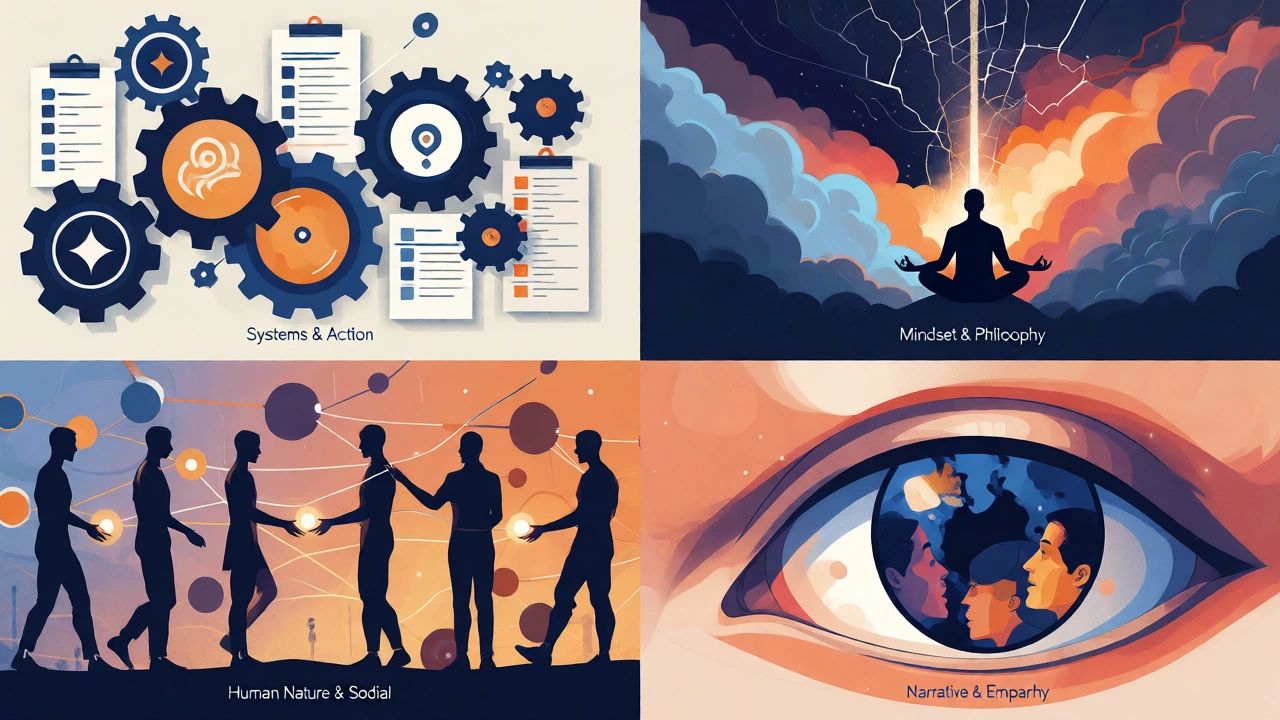
To narrow down the options, we can categorize life-changing books into four distinct pillars. Each pillar addresses a different dimension of the human experience. Identifying which pillar feels most neglected in your life is the fastest way to find your next essential read.
| Pillar | Primary Goal | Best For | Example Titles |
|---|---|---|---|
| Systems & Action | Change behavior | People who know what to do but can't do it | Atomic Habits, Deep Work |
| Mindset & Philosophy | Change perspective | People feeling stuck, anxious, or lacking purpose | Man's Search for Meaning, Meditations |
| Human Nature & Social | Change relationships | People struggling with communication or influence | Influence, How to Win Friends |
| Narrative & Empathy | Expand worldview | People wanting to understand others or themselves better | Sapiens, The Kite Runner |
Let’s break these down. Systems & Action books are practical manuals. They don’t care about your feelings; they care about your output. If you are drowning in email or unable to finish projects, this is your lane. These books provide frameworks, not just inspiration. They turn abstract goals into concrete checklists.
Mindset & Philosophy books operate deeper. They challenge your core beliefs. When you read Man's Search for Meaning, a memoir by Viktor Frankl that details his experiences in Nazi concentration camps and introduces logotherapy, you aren’t learning a technique. You are being confronted with the reality that suffering can have purpose. This shift doesn’t happen overnight, but once it clicks, it recontextualizes every future hardship you face.
Human Nature & Social books decode the people around you. If you feel like everyone else has a manual for social interaction that you missed, these books provide it. They explain why people say yes, why they get angry, and how status games work. Understanding these mechanics reduces anxiety in social settings because you stop taking things personally and start seeing patterns.
Finally, Narrative & Empathy books, including both non-fiction history and literary fiction, expand your mental model of the world. Reading Sapiens, a bestselling book by Yuval Noah Harari that explores the history of humankind forces you to realize that many of our "natural" behaviors are actually cultural constructs. Fiction does something similar by letting you live inside another person’s head, building emotional intelligence in ways that pure data cannot.
Matching the Book to the Moment
Timing matters more than talent. A brilliant book read at the wrong time is forgotten. A simple book read at the right time becomes a bible. How do you know if the timing is right?
- Are you resistant to new information? If you are burned out, skip the dense philosophical texts. Choose something light but insightful, like a collection of essays or a short narrative. Your brain needs bandwidth to process change.
- Are you in a transition period? New job, breakup, move? This is the golden window for identity-based books. You are already questioning who you are, so books about purpose and values land harder.
- Are you stagnant? If you feel bored or complacent, you need disruption. Pick a book that challenges your political, religious, or professional assumptions. Discomfort is the signal that growth is happening.
For example, if you are just starting a business, reading a complex treatise on macroeconomics might overwhelm you. You need tactical advice first. Save the theory for later. Conversely, if you have been running a business for ten years and feel empty, tactical tips won’t help. You need the existential weight of Stoic philosophy or biographies of leaders who faced collapse.
The Danger of "Productive Procrastination"
Here is a trap many readers fall into: buying books as a substitute for doing the work. We buy a book on fitness thinking it will make us fit. We buy a book on finance thinking it will make us rich. This is productive procrastination. The book itself changes nothing. The action taken after the book changes everything.
To avoid this, adopt the "One Idea Rule." After finishing a chapter, write down one specific action you will take based on that chapter. Not three actions. One. If you read a chapter on sleep hygiene, your one action might be "buy blackout curtains." If you read a chapter on negotiation, your action might be "ask for a 5% raise on my next invoice."
This rule transforms reading from passive consumption to active experimentation. It also prevents the overwhelm of trying to implement fifty new habits at once. Small, consistent actions derived from reading compound over time. This is the actual mechanism of life change-not the epiphany, but the execution.
Beyond Self-Help: The Case for Fiction
Many people seeking life-changing reads ignore fiction, assuming it’s just entertainment. This is a mistake. Fiction simulates social scenarios without real-world consequences. It allows you to practice empathy and moral reasoning in a safe environment.
Consider 1984, a dystopian novel by George Orwell that explores themes of surveillance, totalitarianism, and truth. It doesn’t give you a checklist for living, but it fundamentally alters how you view language and authority. Once you see how language can shape thought (Newspeak), you can never unsee it in modern politics or advertising. That is a permanent cognitive shift.
Literary fiction also teaches tolerance for ambiguity. In self-help, problems usually have solutions. In life, they often don’t. Novels like East of Eden or The Brothers Karamazov sit with complexity and contradiction. Learning to navigate ambiguity makes you more resilient in uncertain times. If your life feels chaotic, sometimes you don’t need a solution; you need a companion that understands the chaos. That’s what great fiction provides.

A Practical Framework for Choosing
Still stuck? Use this decision tree to pick your next book:
- Define the Problem: Write down your biggest frustration in one sentence. (e.g., "I can't focus," "I feel lonely," "I hate my job.")
- Categorize the Need: Is this a skill gap, a mindset issue, or a knowledge gap?
- Select the Format: Do you need step-by-step instructions (Non-fiction/How-to) or perspective expansion (Memoir/Fiction)?
- Check the Source: Does the author have lived experience or rigorous research backing their claims? Avoid authors who promise magic bullets.
- Test the First Chapter: Buy or borrow the book. Read the first 10 pages. If it doesn’t spark curiosity or resonance within 15 minutes, drop it. Life is too short for bad books.
Remember, the goal isn’t to read the most popular book. It’s to read the book that speaks to your current version of yourself. The "right" book for you in 2026 might be completely different from the right book for you in 2030. Embrace that fluidity.
Frequently Asked Questions
Do I need to read self-help books to change my life?
No. While self-help books offer direct strategies, novels, biographies, and history books often create deeper, long-term shifts in perspective. Many people find that a powerful story impacts their values more effectively than a list of tips.
What if I forget what I read?
This is normal. Focus on application rather than memorization. Even if you forget 90% of the content, the 10% you apply can transform your life. Taking notes or discussing the book with others helps retention, but action is the true test of understanding.
Is it better to read widely or deeply?
It depends on your goal. If you are building expertise in a niche, read deeply on that topic. If you are looking for creative connections or broader wisdom, read widely across genres. Cross-pollinating ideas from different fields often leads to the most innovative life changes.
Can audiobooks change my life as much as physical books?
Yes, especially for narrative-driven content or motivational material. Audiobooks allow you to consume content during commutes or chores, increasing exposure. However, for dense technical or philosophical texts, physical reading may allow for better comprehension and reflection due to the ability to pause and reread easily.
How many books should I try to read per year?
There is no magic number. Quality trumps quantity. Reading five books a year and applying their lessons is far more effective than reading fifty and retaining none. Set a goal based on your available time and capacity for implementation, not a arbitrary benchmark.