
Personal Development Plan Builder
Build your structured personal development plan using the 6 core components from the article. Enter your details below to generate a complete plan you can implement immediately.
Your Personal Development Plan
Most people think personal development is about reading more books or waking up earlier. But real growth doesn’t happen by accident. It happens when you build a clear, working plan-and stick to it. A personal development plan (PDP) isn’t a fancy journal entry or a vision board you forget after January. It’s a living roadmap that turns vague hopes into measurable progress. And every effective PDP has six core components that work together like gears in a machine.
Self-Assessment: Know Where You Stand
You can’t improve what you don’t measure. Before you set any goals, you need to take a hard look at where you are right now. This isn’t about judging yourself. It’s about gathering facts. What are your strengths? Where do you waste time? What skills are holding you back? What feedback have you ignored from coworkers, friends, or family?Try this: Write down three things you do well and three things you avoid. Then ask someone you trust to do the same. You’ll likely find gaps between your self-perception and reality. That’s normal. The goal isn’t perfection-it’s awareness. For example, someone might think they’re a great communicator, but their team keeps missing deadlines because instructions are unclear. That’s a signal. Self-assessment turns assumptions into data.
Goal Setting: Define What Success Looks Like
Goals without structure are daydreams. A personal development plan needs specific, time-bound targets. Use the SMART framework: Specific, Measurable, Achievable, Relevant, Time-bound. Instead of saying “I want to be more confident,” say “I will speak up in team meetings at least twice a week for the next 60 days.”Break big goals into smaller ones. If your goal is to get promoted in two years, what skills do you need? Public speaking? Project management? Leadership training? List them. Then assign deadlines. People who write down their goals are 42% more likely to achieve them, according to a study by Dominican University. That’s not magic. It’s clarity.
Action Steps: Turn Goals Into Daily Habits
Goals are useless without action. This is where most plans die. You can’t just say “I’ll learn leadership.” You need to know: What will you do Monday? Tuesday? What resources will you use? Who will you talk to?Here’s a real example: Someone wanted to improve their time management. Their action steps were: 1) Block 30 minutes every morning to plan the day, 2) Use a timer for tasks to avoid distraction, 3) Review what worked each Friday. Simple. No apps needed. No complicated systems. Just consistent behavior.
Track your actions. Use a notebook, a spreadsheet, or even a notes app. Don’t rely on memory. Progress isn’t visible unless you record it. Missing a day? Don’t quit. Just reset. Momentum matters more than perfection.
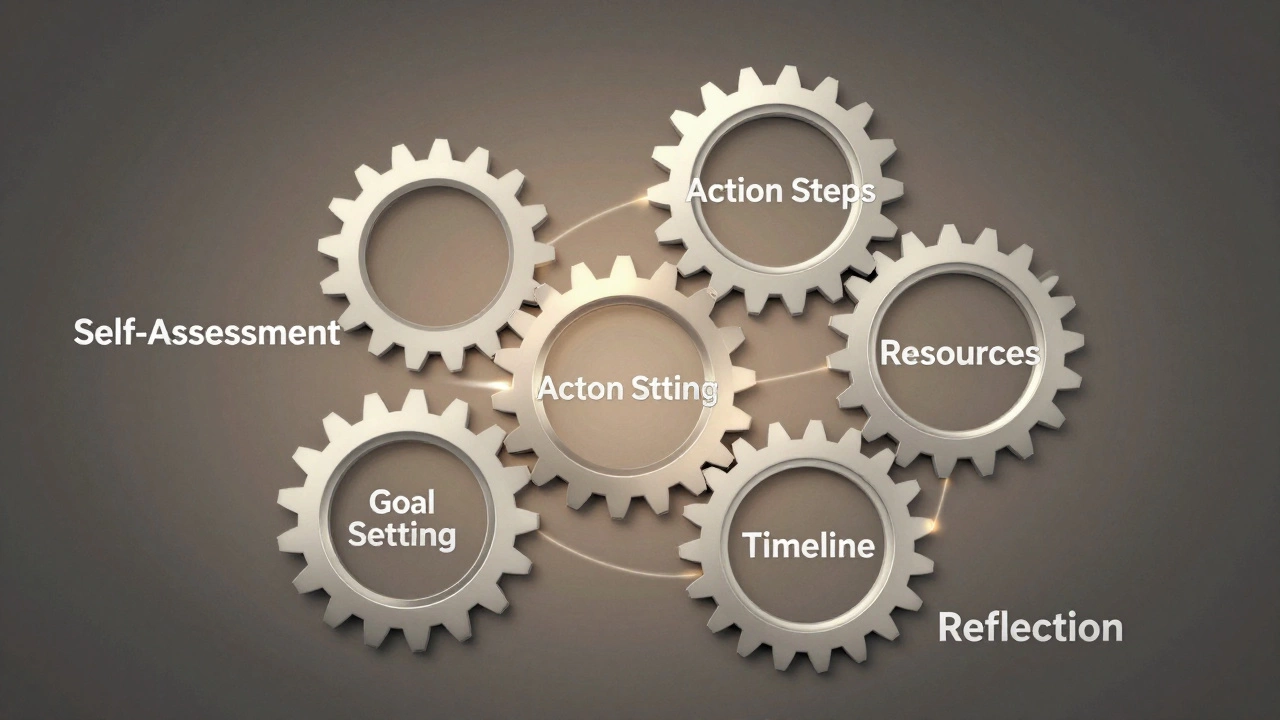
Resources and Support: You Don’t Have to Do It Alone
Personal development isn’t a solo mission. You need tools, people, and access to knowledge. What resources do you need? Books? Online courses? Mentorship? Coaching? A supportive friend who holds you accountable?Many people skip this part because they think asking for help is a weakness. It’s not. It’s strategy. If you’re trying to learn coding, you don’t start from scratch. You use free tutorials, join a Discord group, or find a mentor. If you want to be a better listener, you might read a book like Crucial Conversations or take a workshop. Identify what you need-and go get it.
Also, tell someone your goal. Not just a casual “I’m trying to be better.” Say it out loud: “I’m working on speaking up in meetings. Can you check in with me in two weeks?” That simple act increases your chances of sticking with it by over 65%.
Timeline and Milestones: Build in Checkpoints
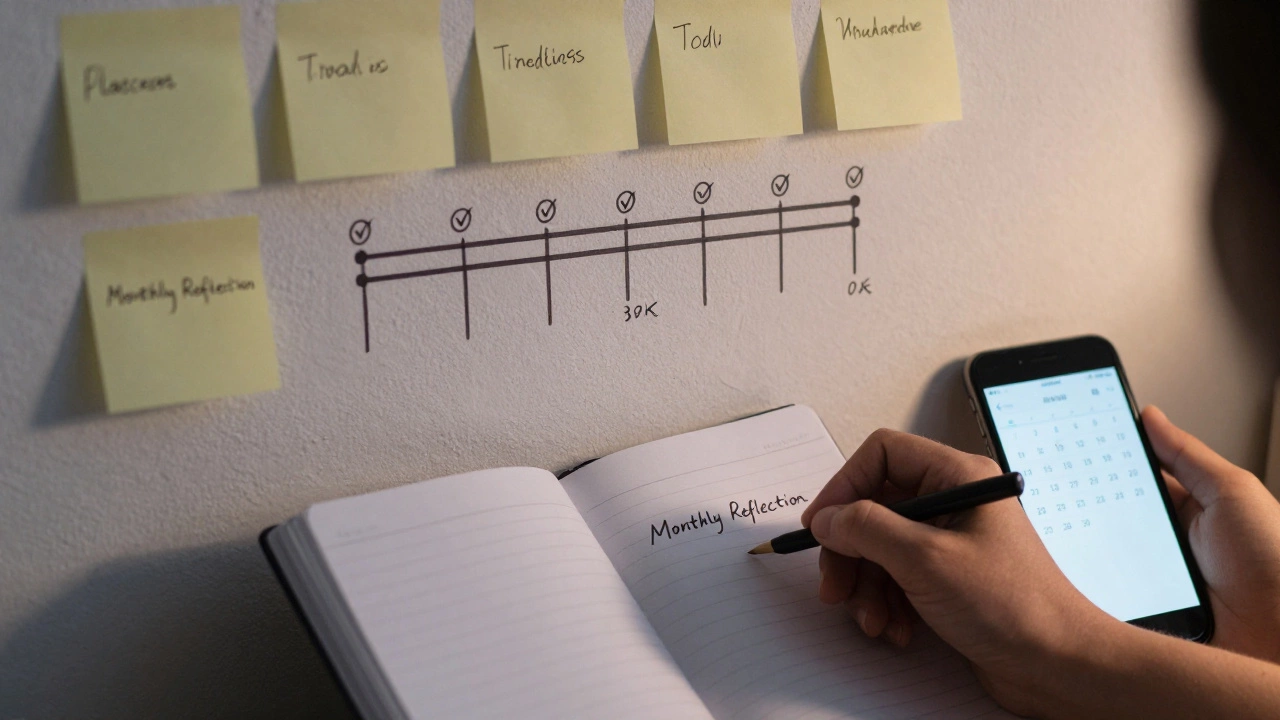
Without deadlines, goals drift. A personal development plan needs clear checkpoints. Set weekly, monthly, and quarterly reviews. Ask yourself: Did I do what I planned? What got in the way? What surprised me?For example, if your goal is to lose 10 kilograms in six months, you don’t wait until the end to see if you’re on track. You weigh yourself every two weeks. You track meals. You adjust if you’re falling behind. The same applies to soft skills. If you’re working on emotional intelligence, check in every month: Did I stay calm during a conflict? Did I listen more than I spoke?
Don’t make your timeline too tight. Too many people burn out because they try to change everything at once. Aim for 2-3 milestones every three months. That’s enough to build momentum without overwhelm.
Reflection and Adjustment: Keep Evolving
Your plan isn’t set in stone. Life changes. Your priorities shift. What worked last month might not work now. That’s okay. The best personal development plans are flexible.Set aside 15 minutes every month to reflect. Ask: What’s working? What’s not? What new opportunity has come up? What skill did I underestimate? Maybe you thought public speaking was your biggest barrier-but now you realize your real issue is saying no to distractions.
Adjust your plan. Swap out a book for a podcast. Replace a weekly meeting with a solo walk to think. Redefine a goal if it no longer fits. Growth isn’t linear. It’s a series of small corrections. The people who improve fastest aren’t the ones who stick rigidly to a plan. They’re the ones who pay attention-and adapt.
Personal development isn’t about becoming someone else. It’s about becoming more of who you already are-only sharper, clearer, and more intentional. The six components aren’t steps you complete. They’re habits you build. Do them once, and you get results. Do them consistently, and you transform.
What’s the difference between a personal development plan and a goal list?
A goal list is just a collection of things you want to do. A personal development plan includes self-assessment, action steps, resources, timelines, and reflection. It’s a system-not a checklist. Goals without structure rarely stick. A plan gives you the framework to make them real.
How long should a personal development plan be?
There’s no fixed length. A good plan can fit on one page. What matters is clarity, not volume. Focus on the six components. If you can explain each one clearly in a few sentences, you’ve done enough. Overcomplicating it leads to procrastination.
Can I have more than six goals in my plan?
You can, but you shouldn’t. Trying to improve too many things at once spreads your energy too thin. Most people succeed by focusing on 1-3 core areas at a time. Once those are solid, you add more. Quality over quantity always wins in personal growth.
Do I need a coach or therapist to make a personal development plan?
No. Many people build effective plans on their own using free tools like journals, templates, or apps. But if you’re stuck, overwhelmed, or dealing with deep habits like anxiety or self-doubt, a coach or therapist can help you see blind spots. They’re not required-but they can speed things up.
What if I fail to meet my goals?
Failure isn’t the opposite of progress-it’s part of it. If you miss a deadline, don’t quit. Ask why. Was the goal too big? Did something unexpected happen? Did you lose motivation? Use that insight to adjust your plan. Every misstep is data. The only real failure is giving up.
How often should I update my personal development plan?
Review it every month. Make major updates every 3-6 months. Life changes-your job, your health, your relationships. Your plan should change too. Treat it like a software update: small patches weekly, big upgrades seasonally.
Next Steps: Start Today
You don’t need to wait for Monday. You don’t need a perfect template. Open a blank document right now. Write down one thing you want to improve. Then ask yourself: What’s my current reality? What’s my goal? What’s the first small step I can take this week? Who can help me? When will I check in?That’s your plan. It’s not fancy. But it’s real. And that’s what matters.