When people think of fantasy novels, they often picture wizards, dragons, and epic battles between good and evil. But the genre didn’t start with The Lord of the Rings or Harry Potter. The very first novel that fully fits the modern definition of fantasy wasn’t written in the 20th century-it was written in 1858. And it wasn’t about kingdoms or chosen ones. It was about a man who wakes up in a world where everything is slightly off, where furniture talks, and where mirrors lead to deeper truths.
The book is called Phantastes, written by Scottish author George MacDonald. It’s not well known today, but it’s the root of nearly every fantasy novel that came after it. Tolkien read it as a teenager and called it a book that "opened the door" to his own imagination. C.S. Lewis called MacDonald "my master." Without Phantastes, modern fantasy as we know it might not exist.
What Makes Phantastes the First Fantasy Novel?
To call something the "first" of anything, you need clear criteria. Fantasy as a genre isn’t just about magic. It’s about a world that operates under rules different from our own, where the impossible is normal, and where the inner life of a character shapes the outer world. Phantastes does all of this.
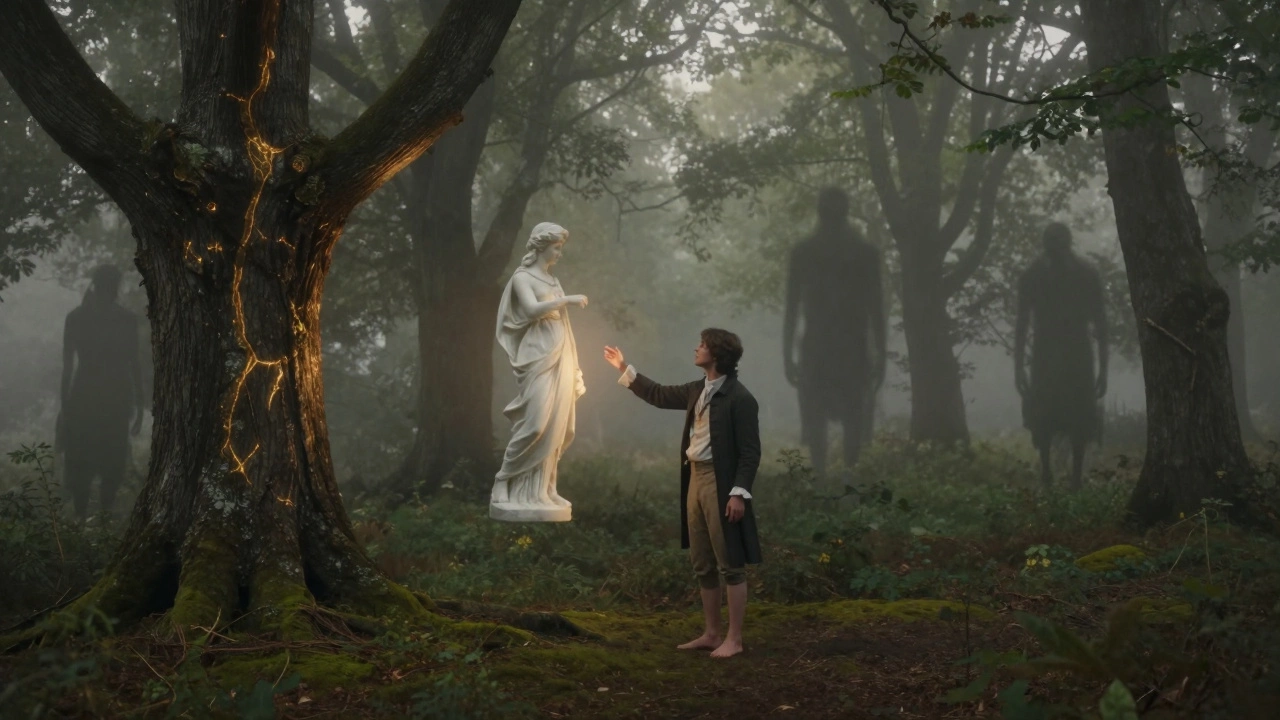
The story follows Anodos, a young Englishman who enters a dreamlike realm after finding a strange marble statue. In this world, trees sing, shadows take human form, and a female spirit named the "Lady" guides him through trials that mirror his fears and desires. There are no swords, no armies, no quests to save a kingdom. Instead, Anodos wrestles with pride, loneliness, and the temptation to control others. The magic here isn’t a tool-it’s a mirror.
Earlier works had magical elements. Homer’s Odyssey had gods and monsters. Edmund Spenser’s The Faerie Queene had knights and enchantresses. But these were poems or allegories, not novels. They didn’t center on a single character’s psychological journey through a fully realized alternate world. Phantastes was the first to do that. It didn’t just use fantasy-it built a world that felt real, with its own logic, emotions, and consequences.
Why Earlier Books Don’t Count
Some people point to Le Morte d’Arthur or Don Quixote as early fantasy. But neither qualifies. Le Morte d’Arthur is rooted in medieval legend and treated as history by its readers. Don Quixote is satire. The magic in those books is either believed to be real by the characters (making them historical fiction) or clearly absurd (making them comedy). Fantasy, as a genre, requires the reader to accept the magical world as legitimate-not as a joke or a myth, but as a place with its own truth.
Even Paradise Lost, with its fallen angels and cosmic battles, is theological poetry, not a novel. It doesn’t follow a character’s personal transformation through a secondary world. Phantastes does. It’s structured like a modern novel: a beginning, a middle, an end. Anodos changes. He fails. He learns. He grows. That’s what makes it the first fantasy novel.
How It Influenced the Genre
George MacDonald didn’t set out to create a new genre. He was a preacher and a writer of Christian allegories. But his imagination was too wild to be contained by doctrine. He wrote what he saw in dreams, and those dreams became a blueprint.
Tolkien read Phantastes in 1911, at age 19. He later said it gave him "a sense of the numinous"-a feeling that the world held hidden depths. That feeling directly shaped the tone of Middle-earth. The way elves move in Tolkien’s books, the quiet magic of Lothlórien, the sense that nature has a soul-all of it echoes MacDonald’s vision.
C.S. Lewis was even more direct. He wrote that reading Phantastes was "the moment I became a fantasy writer." The Chronicles of Narnia owe their emotional core to MacDonald’s work. The White Witch’s icy castle, the talking beasts, the deep longing for a better world-these aren’t just borrowed. They’re inherited.
Even modern authors like Neil Gaiman and Patricia McKillip cite MacDonald as a foundational influence. The way fantasy today balances wonder with emotional weight? That’s MacDonald’s legacy.
Why Phantastes Is Still Relevant
Today’s fantasy is full of world-building, magic systems, and intricate politics. But too often, it forgets what made the genre powerful in the first place: the inner journey.
Phantastes doesn’t explain how magic works. It doesn’t have spells or runes. Instead, it shows how a person’s soul shapes their reality. When Anodos becomes arrogant, the world around him turns cold and hostile. When he learns humility, flowers bloom where he walks. It’s not about power-it’s about transformation.
That’s why Phantastes still speaks to readers today. In a world obsessed with spectacle, it reminds us that the deepest magic is the change inside us. The first fantasy novel wasn’t about defeating a dark lord. It was about learning to face yourself.
What to Read Next
If you’ve read Phantastes and want to explore its descendants:
- The Chronicles of Narnia by C.S. Lewis-especially The Lion, the Witch and the Wardrobe and Prince Caspian
- The Lord of the Rings by J.R.R. Tolkien-notice how the quiet beauty of Rivendell mirrors MacDonald’s forests
- Jonathan Strange & Mr Norrell by Susanna Clarke-this book blends historical realism with quiet, eerie magic in a way MacDonald would recognize
- The Once and Future King by T.H. White-another reimagining of Arthurian myth with deep psychological insight
- Little, Big by John Crowley-modern fantasy that feels like a dream you can’t quite wake from
These books all carry the DNA of Phantastes. They don’t copy it-they expand it. That’s the mark of a true origin story.
Myth and Memory
Fantasy didn’t begin with dragons. It began with a quiet, thoughtful man in 19th-century Scotland, writing about a boy who walked into a world of shadows and flowers. He didn’t write for fame. He didn’t write for sales. He wrote because he had to. And in doing so, he gave the world a new way to see itself.
The first fantasy novel wasn’t loud. It wasn’t flashy. But it was true. And that’s why it still matters.
Is Phantastes the same as The Princess and the Goblin?
No. The Princess and the Goblin is another fantasy novel by George MacDonald, published in 1872. It’s more child-friendly and has clearer plot structures-goblins, a princess, a miner boy. But it came after Phantastes. While both are important, Phantastes was the first to fully realize the psychological depth and dreamlike logic that define modern fantasy.
Did any other authors write fantasy before 1858?
Yes, but not as novels. Writers like William Blake and E.T.A. Hoffmann wrote fantasy stories and poems. Hoffmann’s "The Sandman" (1816) has eerie magic and psychological horror, but it’s a short story. Blake’s mythic visions were poetic, not narrative. None of them created a sustained, novel-length journey through a secondary world with a single character’s inner transformation as the core.
Why isn’t Phantastes more popular today?
It’s written in a 19th-century style-slow, poetic, and deeply introspective. Modern readers often expect fast pacing and clear stakes. Phantastes doesn’t give either. It’s a book for quiet reflection, not action. But that’s also why it’s powerful. It asks you to slow down, to feel, to question. It’s not for everyone-but for those who connect with it, it changes how they see fantasy forever.
Was George MacDonald the first to use fantasy elements?
No. Myths, fairy tales, and religious allegories have used fantasy for thousands of years. But MacDonald was the first to use those elements to build a full, self-contained novel where the magic serves the character’s emotional growth-not just plot or spectacle. He turned fantasy from a tool into a lens.
Can I still read Phantastes today?
Yes. It’s in the public domain and available for free online through Project Gutenberg and other digital archives. Many print editions are also available from publishers like Dover Classics and Oxford University Press. It’s short-under 200 pages-and reads like a dream you don’t want to wake from.