
Find Your Next Romance Novel
Not sure which romance novel to read next? Use this tool to get a personalized recommendation based on your preferred mood and reading style.
Walk into any airport bookstore or scroll through Amazon’s top charts, and you’ll see a sea of red and pink spines. Romance is the undisputed heavyweight champion of fiction sales. But if you asked ten people which specific romance novel has sold the most copies in history, you’d likely get ten different answers. Some will shout out Pride and Prejudice. Others will defend Outlander. A few might even mention a paperback by Nicholas Sparks.
The truth is messier than a single title. There isn’t one definitive "most bought" romance novel because tracking global sales across two centuries is nearly impossible. However, we can narrow it down to a few heavy hitters that dominate the conversation based on verified print runs, publisher data, and historical estimates. If you want to know which books have truly moved the needle for readers worldwide, here is the breakdown.
The Historical Giant: Pride and Prejudice
If we are talking about raw numbers over time, Pride and Prejudice is a classic romantic novel by Jane Austen published in 1813 that explores class and marriage in Regency England takes the crown. It is not just a romance; it is a cultural artifact. Since its publication, it has never been out of print. Estimates suggest it has sold between 20 million and 40 million copies globally. When you factor in free public domain downloads and countless film adaptations that drive new readers to the text, the number is staggering.
Why does it still sell? Because the core dynamic-misunderstanding leading to deep respect and love-resonates regardless of the century. Readers don’t buy it for the plot twists; they buy it for the comfort of Elizabeth Bennet’s wit and Mr. Darcy’s eventual surrender. It sets the baseline for all other romance novels. If you haven’t read it, you’re missing the blueprint.
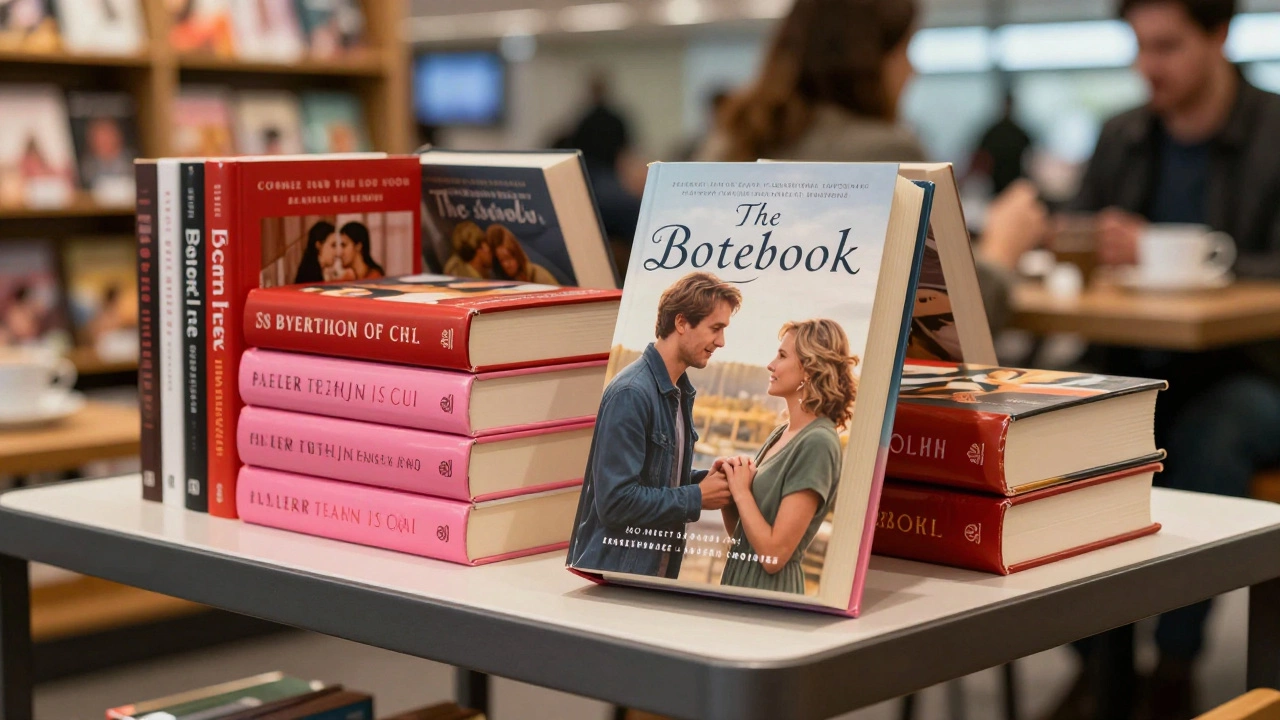
The Modern Blockbuster: Nicholas Sparks’ The Notebook
Jump forward to the late 20th and early 21st centuries, and the landscape changes. Enter Nicholas Sparks, an American author known for emotionally charged contemporary romance novels often set in North Carolina. His 1996 debut, The Notebook, became a phenomenon. While exact lifetime sales figures are guarded closely by publishers, industry analysts estimate that Sparks’ backlist, led by The Notebook, has sold well over 50 million copies combined. The Notebook alone is estimated to have sold more than 15 million copies.
Sparks mastered the formula of high-stakes emotional payoff. He paired his books with major Hollywood adaptations, creating a feedback loop where moviegoers bought the book and vice versa. For many modern readers, this is the definition of a "best-selling romance." It’s accessible, heartbreaking, and deeply sentimental. If your metric for "most bought" is consistent annual sales over the last thirty years, Sparks is a strong contender.
The Series Powerhouse: Diana Gabaldon’s Outlander
Then there is the series effect. Outlander is a historical science fiction romance series by Diana Gabaldon featuring time travel and Scottish Highland history has become a publishing juggernaut. The first book, published in 1991, took years to find its footing, but once it did, it exploded. By 2025, the entire series had sold over 30 million copies worldwide. The first book, Outlander, accounts for a massive chunk of that.
What makes Outlander unique in the "most bought" conversation is its longevity and fan engagement. Unlike standalone hits, this series keeps readers buying year after year. The TV adaptation on Starz further boosted sales, introducing the characters to a generation that might not have picked up a 900-page historical epic otherwise. For readers who prefer depth, historical detail, and complex character arcs, this is the gold standard.
Comparing the Titans
| Book Title | Author | Publication Year | Estimated Sales | Key Appeal |
|---|---|---|---|---|
| Pride and Prejudice | Jane Austen | 1813 | 20M-40M+ | Cultural icon, witty dialogue, timeless themes |
| The Notebook | Nicholas Sparks | 1996 | 15M+ (single title) | Emotional intensity, movie tie-in, accessibility |
| Outlander | Diana Gabaldon | 1991 | 30M+ (series total) | Historical detail, fantasy elements, long-form storytelling |
| Me Before You | Jojo Moyes | 2012 | 10M+ | Contemporary drama, ethical dilemmas, quick read |
Looking at these numbers, you can see why pinning down a single winner is tricky. Austen wins on historical accumulation. Sparks wins on consistent modern popularity. Gabaldon wins on series loyalty. Each represents a different era and style of romance reading.
Why Tracking Romance Sales Is Hard
You might wonder why publishers don’t just release a clear leaderboard. The issue lies in how sales are tracked. Nielsen BookScan and similar services only track point-of-sale data from participating retailers. This misses library loans, second-hand sales, international markets outside major English-speaking countries, and digital-only purchases that aren’t reported uniformly.
Furthermore, "romance" is a broad category. Does Gone with the Wind count? It’s often classified as historical fiction, but it’s undeniably a romance. What about self-published authors like E.L. James, whose Fifty Shades of Grey sold over 125 million copies? Many purists argue it’s erotica, not traditional romance, but commercially, it fits the bill. If you include Fifty Shades, it technically outsells everything else mentioned here. However, in mainstream literary discussions, it is often treated separately due to its genre-blurring nature.
The Rise of Self-Published Romance
In recent years, the indie publishing boom has shifted the landscape again. Authors like Sylvia Day and Ana Huang have generated tens of millions in revenue through direct-to-consumer platforms like Kindle Direct Publishing. Exact copy counts are harder to verify, but their influence is undeniable. They bypass traditional gatekeepers, allowing them to test covers, blurbs, and pricing in real-time. This agility means they can sustain high sales volumes without the marketing budgets of big houses.
For the average reader, this means more variety. You’re no longer limited to what a few big publishers decide to push. If you enjoy spicy, fast-paced romances, the indie market is likely where the highest volume of new reads is happening today.
How to Choose Your Next Romance Read
Knowing which books sell the most doesn’t automatically mean they’re right for you. Bestsellers reflect mass appeal, not personal taste. Here is how to use this information:
- If you want comfort: Go with Pride and Prejudice. It’s safe, familiar, and beautifully written.
- If you want a cry: Pick The Notebook or Jojo Moyes’ Me Before You. These are designed to tug at your heartstrings.
- If you want adventure: Start with Outlander. It’s a commitment, but the world-building is unmatched.
- If you want spice: Look into the indie bestsellers on Amazon or Goodreads. Search for tags like "contemporary romance" or "paranormal romance" to find current trends.
Sales figures are a useful guide, but your enjoyment is the only metric that matters. Don’t let the hype pressure you into finishing a book you dislike. Romance is diverse. Find the subgenre that speaks to you.
Common Misconceptions About Romance Sales
Many people assume that romance novels are only popular among women. While female readers make up the majority of the audience, male readership is growing, especially in the paranormal and erotic subgenres. Additionally, there is a myth that best-selling romances are poorly written. While some mass-market paperbacks prioritize plot over prose, authors like Austen, Gabaldon, and Moyes are celebrated for their literary merit. Sales do not equal low quality.
Another misconception is that older romances are irrelevant. In reality, classics like Austen’s work continue to inspire modern retellings. Books like Bridget Jones’s Diary are essentially updates of Pride and Prejudice. Understanding the classics helps you appreciate the evolution of the genre.
Final Thoughts on Reading Romance
There is no single "most bought" romance novel that satisfies every criteria. If you count historical accumulation, it’s Austen. If you count modern standalone impact, it’s Sparks. If you count series dominance, it’s Gabaldon. And if you count sheer commercial volume including erotica, it’s James. The beauty of romance is that there is something for everyone. Whether you prefer the slow burn of a period piece or the immediate heat of a contemporary thriller, the genre offers endless options. Keep reading, keep exploring, and don’t be afraid to jump into a series that captivates you.
Is Fifty Shades of Grey considered a romance novel?
It depends on who you ask. Commercially, it is categorized under romance and erotica. Literary critics often classify it as erotic fiction due to its explicit content and focus on BDSM dynamics. While it shares the central theme of a developing relationship, its primary appeal differs from traditional romance novels that focus on emotional connection and happy endings.
Why do romance novels sell so well?
Romance novels offer a guaranteed emotional payoff. Readers know the couple will end up together, which provides comfort and predictability in an uncertain world. The genre focuses on relationships, empathy, and emotional growth, which resonates deeply with a wide audience. Additionally, the variety of subgenres ensures there is always a new story to discover.
Who is the best-selling romance author of all time?
Barbara Cartland is often cited as the best-selling romance author of all time, with estimated sales of over 700 million copies. However, her works are largely forgotten today. Among living authors with significant current relevance, Danielle Steel and Nora Roberts are top contenders, each with hundreds of millions of copies sold across decades of writing.
Are Pride and Prejudice sales accurate?
Exact numbers are difficult to verify because the book is in the public domain. Any publisher can print and sell it without reporting royalties to a central authority. Estimates range widely from 20 million to over 100 million when including free downloads and educational copies. It is undoubtedly one of the most read books in history, but precise sales data is unavailable.
What is the difference between romance and romantic fiction?
Romance novels must have a central love story and a happily-ever-after (HEA) or happy-for-now (HFN) ending. Romantic fiction may feature love as a subplot but does not require a positive resolution for the relationship. For example, Gone with the Wind is romantic fiction because the central relationship ends tragically, whereas The Notebook is a romance because it ends with the couple reunited.