
Fahrenheit 451 Age Readiness Checker
Select the reader's age and experience level to see a personalized recommendation based on educational standards and emotional readiness.
Key Considerations
Select an age and experience level above to generate a recommendation.
You’re standing in the library aisle, holding a copy of Fahrenheit 451 by Ray Bradbury. It’s short-barely over 150 pages. The cover looks intense but not scary. You think, "This could be great for my kid." Then you remember the reviews mentioning heavy themes, violence, and complex symbolism. Suddenly, that simple question becomes a maze: Is this too much? Is it too little? What grade reads Fahrenheit 451?
Here is the straight answer before we unpack the "why": Most schools assign Fahrenheit 451 to students in 9th or 10th grade (ages 14-16). However, advanced readers can handle it in 8th grade, while sensitive younger teens might need to wait until 11th grade. It’s not just about reading speed; it’s about emotional readiness.
The Official Reading Level vs. Reality
Let’s look at the data. Lexile scores often place dystopian fiction like this in the 900L-1100L range. That technically aligns with middle school levels. But here is the catch: Lexile measures sentence complexity and word frequency, not emotional weight. A book can have simple sentences but devastating themes. Bradbury’s prose is poetic, which adds a layer of difficulty that standard metrics miss.
Think of it like driving. An 8th grader might know how to operate the car (read the words), but do they have the judgment to handle highway traffic (interpret the satire)? That’s where parental guidance comes in. If your child loves The Giver or The Hunger Games, they likely have the vocabulary. But Fahrenheit 451 is slower, more philosophical, and less action-driven than those titles.
Why Schools Wait Until High School
Educators usually hold back this novel for high school because of three specific hurdles: thematic density, historical context, and moral ambiguity.
- Thematic Density: The book isn’t just about firemen burning books. It’s a critique of censorship, mass media, and anti-intellectualism. Grasping why Bradbury wrote this in 1953 requires understanding post-war America, McCarthyism, and the rise of television. Without that context, the story feels flat.
- Moral Ambiguity: The protagonist, Guy Montag, doesn’t start as a hero. He’s complicit in the system. Younger readers often struggle with characters who aren’t clearly "good" or "bad." They want black-and-white morality; Bradbury gives them gray smoke.
- Pacing: Modern teens are used to fast-paced narratives. Fahrenheit 451 has long passages of dialogue and internal monologue. Patience is required.
If you force an eager 12-year-old to read it without discussion, they might finish it but miss the point entirely. They’ll see it as a sci-fi adventure rather than a warning about society.
| Grade Level | Typical Age | Readiness Indicators | Potential Challenges |
|---|---|---|---|
| 7th-8th Grade | 12-14 | Advanced reader, interested in history/politics, handles abstract concepts. | Boredom due to pacing; confusion over satire; needs parental mediation. |
| 9th-10th Grade | 14-16 | Standard curriculum fit; capable of analyzing symbolism; understands social pressure. | May find the ending ambiguous; needs help connecting 1950s context to today. |
| 11th-12th Grade | 16-18 | Deep critical analysis possible; compares well with Brave New World or 1984. | May feel the plot is simplistic if they’ve read other dystopias first. |
Content Warnings: What’s Actually In There?
Parents often ask about the "scary" parts. Let’s be concrete. This isn’t horror. There are no monsters jumping out of closets. But there is psychological intensity.
There is a scene involving a woman choosing to burn herself with her books rather than live without them. It’s shocking and sad. For a sensitive 13-year-old, this moment can linger uncomfortably. There is also mild profanity and references to suicide. The violence is mostly implied or off-screen, but the threat of firemen arriving at your door creates constant tension.
Compare this to Brave New World, which deals with sexual content and drug use explicitly. Fahrenheit 451 is cleaner in terms of physical intimacy but heavier in existential dread. If your child gets anxious about authority figures or loss of control, approach with caution.

How to Decide If Your Child Is Ready
Don’t rely solely on their age. Ask these questions instead:
- Do they enjoy non-action stories? Can they sit through a chapter where two people just talk about philosophy? If they only like battles and chases, they will hate this book.
- Have they read other dystopias? If they’ve finished The Handmaid’s Tale (adult version) or Ender’s Game, they have the framework.
- Are they curious about "why" things happen? This book asks big questions about technology and happiness. If they prefer clear answers, this will frustrate them.
- Can they handle ambiguity? The ending isn’t a neat bow. It’s open-ended. Do they get upset when stories don’t wrap up perfectly?
If you answered "yes" to most of these, try the book. Start with Part One together. Discuss what’s happening after each section. This turns a solo read into a shared intellectual journey, which is exactly what Bradbury intended.
Alternatives for Younger Readers
If Fahrenheit 451 feels too heavy right now, don’t worry. There are excellent bridges to the same themes.
The Giver by Lois Lowry is the classic stepping stone. It introduces memory, conformity, and societal control in a way that is emotionally accessible for 11-12 year olds. Once they grasp the concept of a "perfect" society hiding dark secrets, they are primed for Bradbury.
Unwind by Neal Shusterman offers a faster pace and more immediate danger, dealing with bodily autonomy and government overreach. It hooks reluctant readers quickly.
Feed by M.T. Anderson tackles the media saturation theme directly. It uses slang and a modern voice to discuss how technology changes human connection. It’s often easier for digital-native teens to relate to than Bradbury’s 1950s perspective.
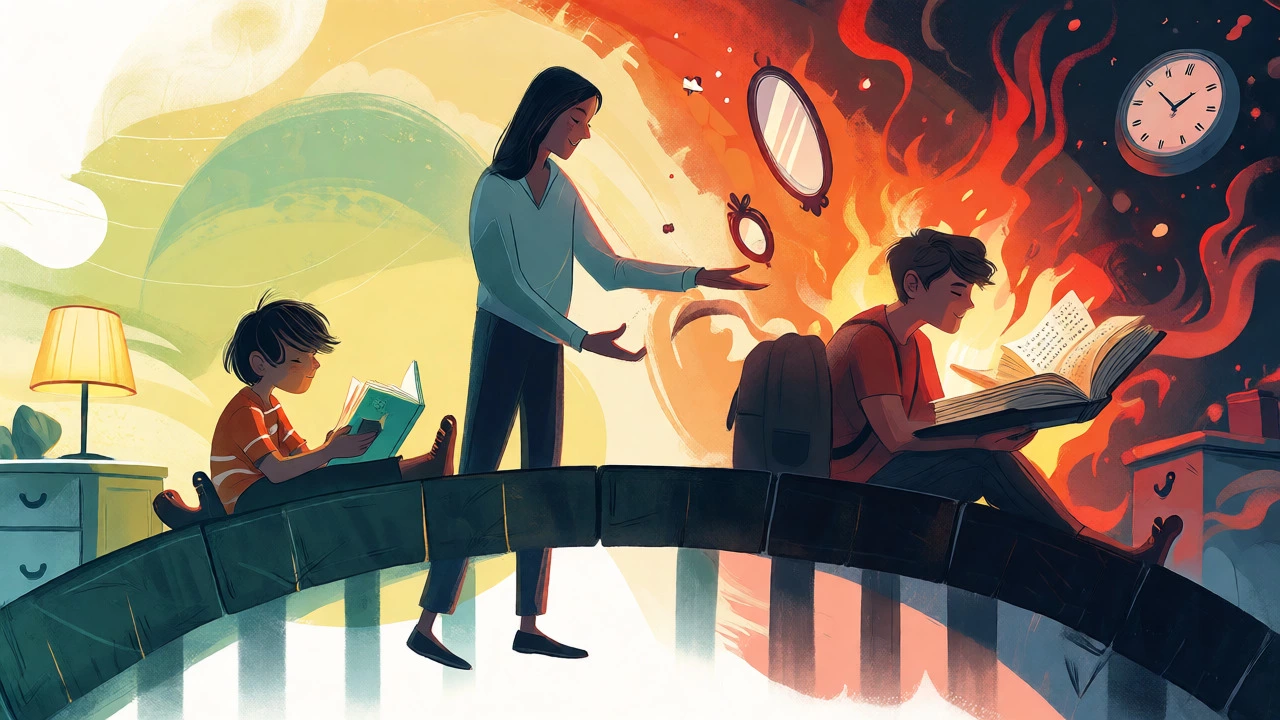
Tips for Parents and Teachers
If you decide to go ahead, here is how to make the experience stick.
Context is King: Before opening page one, show them a clip of 1950s television commercials. Explain the fear of nuclear war. Explain what it meant to be "un-American" during the Red Scare. Without this, Montag’s rebellion feels random. With it, it feels urgent.
Connect to Today: Ask them: "Where do we see 'firemen' today? Who decides what information we see?" Social media algorithms, cancel culture, and news bubbles are perfect modern parallels. This makes the book feel relevant, not dusty.
Accept Boredom: Tell them it’s okay to find parts slow. Bradbury’s style is lyrical, not kinetic. Encourage them to highlight lines that sound beautiful or strange. Turning reading into an active hunt for language helps maintain engagement.
Watch the Adaptations: There are several film versions. Watch one together after finishing the book. Compare the visuals to their imagination. This reinforces comprehension and sparks debate about what was lost or gained in translation.
Final Verdict
So, what grade reads Fahrenheit 451? Ideally, 9th or 10th grade. But education isn’t linear. If you have a thoughtful, patient 13-year-old who loves deep conversations, hand them the book. Sit with them. Talk about the fire. Talk about the silence. They might surprise you.
And if they’re not ready? Put it on the shelf. Revisit it next year. Great books wait for us. They don’t expire. The goal isn’t to check a box on a reading list; it’s to plant a seed about the value of ideas. Sometimes, waiting until the mind is ripe ensures the lesson actually takes root.
Is Fahrenheit 451 appropriate for a 12-year-old?
It depends on the child's maturity. While the vocabulary is manageable for advanced 12-year-olds, the themes of self-immolation, existential despair, and political oppression are heavy. Most educators recommend waiting until age 14 unless the child has strong critical thinking skills and emotional resilience.
Why is Fahrenheit 451 assigned in high school?
High school curricula focus on literary analysis, symbolism, and historical context. Fahrenheit 451 allows students to practice interpreting metaphors (fire, hounds, mirrors) and discussing the relationship between literature and society. These analytical skills are harder to develop in younger grades where narrative enjoyment often takes precedence.
Is Fahrenheit 451 hard to read?
Physically, no-it is under 200 pages. Intellectually, yes. Bradbury uses dense, poetic prose and allusions to classic literature that require background knowledge. The pacing is also slow compared to modern young adult novels, which can test a reader's patience.
What should I read before Fahrenheit 451?
Reading The Giver by Lois Lowry or The Chrysalids by John Wyndham provides a gentle introduction to dystopian tropes. Understanding basic concepts of censorship and propaganda from history classes also helps significantly. Familiarity with George Orwell’s 1984 can provide a useful comparison point.
Does Fahrenheit 451 contain bad language?
There is mild profanity, but it is not excessive. The language reflects the era and character voices rather than being gratuitous. The bigger concern for parents is usually the violent imagery and the tone of hopelessness rather than swear words.