Personal Growth Stage Identifier
Answer these two questions about your current skill or habit to discover where you stand on the growth curve.
You’ve probably read the book, bought the planner, and set ambitious goals for the year. Yet, months later, you’re back where you started. Why? Because most people treat personal growth like a switch you flip, rather than a cycle you navigate. Understanding that change happens in distinct phases can save you from frustration and burnout.
Psychologists and developmental theorists have long observed that human behavior doesn’t shift overnight. It moves through predictable patterns. While there are many models, the most practical framework for everyday life breaks personal growth down into four core stages: Unconscious Incompetence, Conscious Incompetence, Conscious Competence, and Unconscious Competence. These aren't just academic terms; they are the roadmap for how we actually learn, adapt, and improve ourselves.
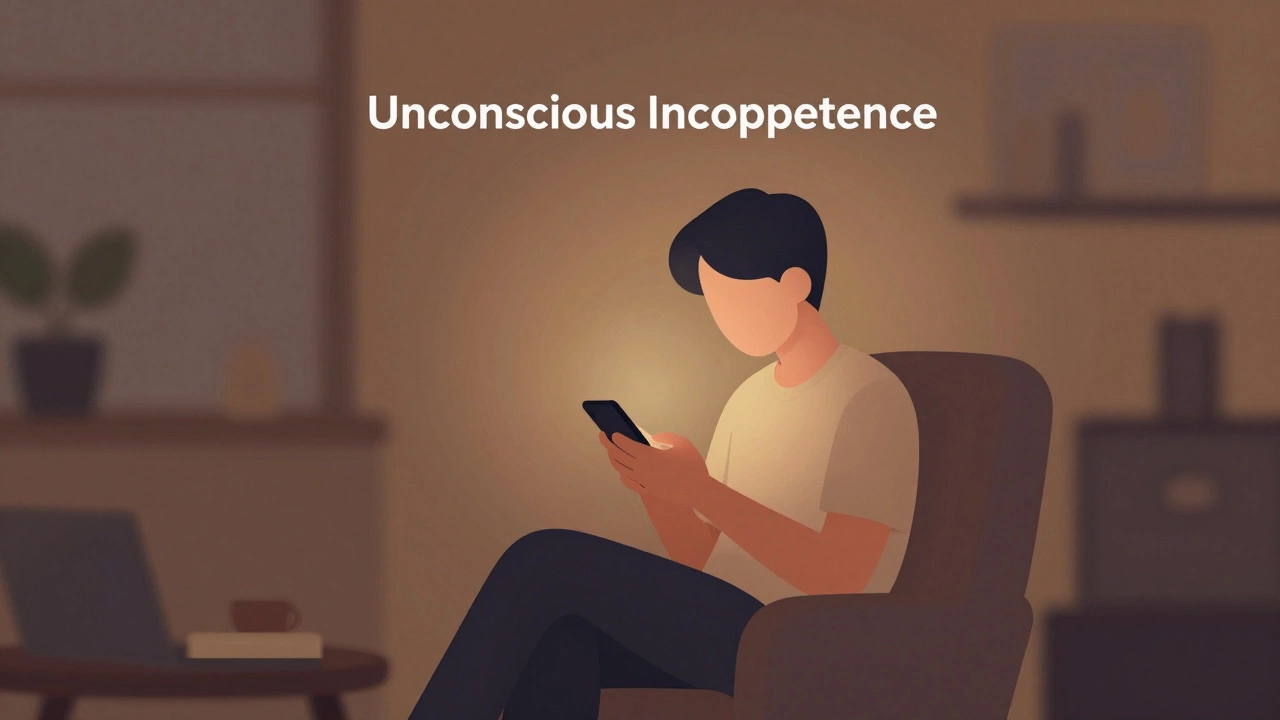
Stage 1: Unconscious Incompetence (The Comfort Zone)
We all start here. This stage is defined by not knowing what you don’t know. You might be spending hours scrolling through social media instead of working on your passion project, but you don’t realize it’s hurting your productivity. You feel fine. You’re comfortable. There is no pain, so there is no perceived need for change.
In this phase, your brain operates on autopilot. Habits run deep, and blind spots are wide open. For example, you might speak aggressively in meetings without realizing it intimidates your colleagues. Because you lack awareness of the impact, you see no reason to adjust your tone. This isn’t laziness; it’s simply a lack of data. Your internal feedback loop is broken because you aren’t measuring the outcome against a standard of excellence you haven’t yet adopted.
The danger of staying in Stage 1 is stagnation. Without an external trigger-a harsh performance review, a breakup, or a health scare-you will remain exactly where you are. The goal here isn’t to force change immediately, but to recognize that comfort is often the enemy of progress.
Stage 2: Conscious Incompetence (The Awareness Phase)
Something shifts. Maybe you get that feedback at work, or you finally look at your bank account and panic. Suddenly, you see the gap between where you are and where you want to be. This is Conscious Incompetence. You now know what you’re doing wrong, but you still can’t do it right.
This is often the most painful stage of personal growth. It feels frustrating because your standards have risen, but your skills haven’t caught up yet. You try to meditate, but your mind races. You try to cook healthy meals, but you burn the rice. You attempt to communicate better, but you stumble over your words. Many people quit here because the effort feels disproportionate to the reward. They mistake this discomfort for failure, when in reality, it is the sensation of learning.
To survive this stage, you need patience and a new metric for success. Stop judging yourself by results and start judging yourself by consistency. If you show up to practice every day, even if you suck at it, you are winning. Acknowledge the gap, accept the awkwardness, and keep going. This is where character is built.
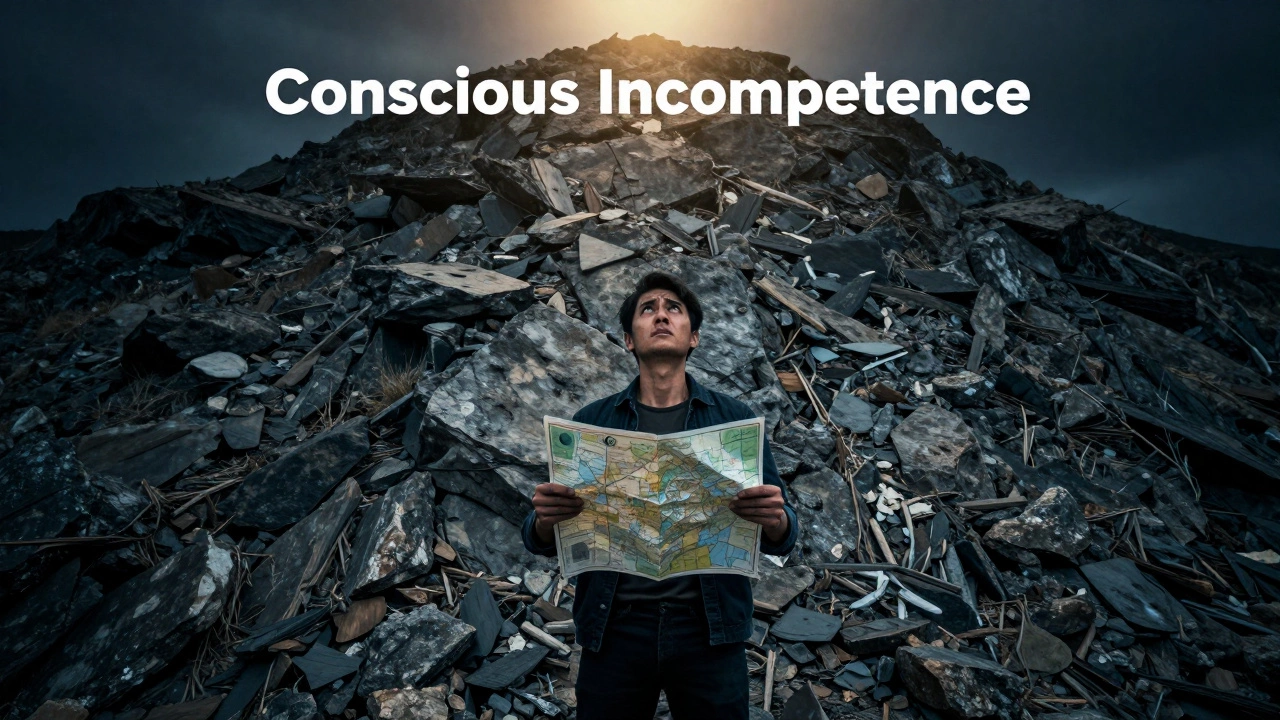
Stage 3: Conscious Competence (The Effortful Practice)
After weeks or months of grinding through Stage 2, something clicks. You start to get things right more often than not. You can hold a difficult conversation without exploding. You can stick to your budget. You can focus on your work for an hour without checking your phone. Welcome to Conscious Competence.
You have the skill, but it still requires intense mental energy. Think about driving a car in heavy traffic for the first time. You know how to drive, but you are hyper-aware of every lane change, every brake light, and every mirror check. It’s exhausting. If someone talks to you while you’re navigating a complex negotiation or playing a musical instrument you’ve recently learned, you might falter because your attention is split.
In this stage, discipline is your best friend. Motivation will fluctuate, but systems will carry you. Create routines that reduce decision fatigue. If you want to write, sit down at the same desk at the same time every day. Don’t rely on inspiration; rely on structure. This phase can last a long time-sometimes years-depending on the complexity of the skill. The key is to maintain focus until the conscious effort begins to fade.
Stage 4: Unconscious Competence (Mastery and Integration)
Eventually, the hard work becomes second nature. You stop thinking about the mechanics and start focusing on the nuance. You can drive home from work and not remember the trip because your body handled it automatically. You can listen to a colleague’s grievance and respond with empathy without mentally rehearsing your response. This is Unconscious Competence.
This is the stage of mastery. The skill has been integrated into your identity. You are no longer “trying” to be healthy; you are a healthy person. You are no longer “practicing” kindness; you are kind. The behavior is effortless because it aligns with who you are. This frees up massive amounts of cognitive bandwidth for other areas of life. You can now take on new challenges because your foundational habits are running on autopilot.
However, beware of complacency. Unconscious competence can lead to rigidity if you stop challenging yourself. The moment you think you’ve “arrived,” you risk sliding back into unconscious incompetence in new areas. True personal growth is recursive. Once you master one area, you identify a new blind spot and start the cycle again.
| Stage | Awareness Level | Skill Level | Primary Emotion | Action Required |
|---|---|---|---|---|
| 1. Unconscious Incompetence | Low | Low | Comfort / Ignorance | Seek feedback & education |
| 2. Conscious Incompetence | High | Low | Frustration / Anxiety | Patient practice & persistence |
| 3. Conscious Competence | High | High | Fatigue / Focus | Discipline & routine building |
| 4. Unconscious Competence | Low (Automatic) | High | Flow / Confidence | Maintenance & teaching others |

How to Move Between Stages Faster
Understanding these stages is useful, but moving through them efficiently is the real goal. Here are specific strategies to accelerate your progress.
Breaking Out of Stage 1
You cannot fix what you do not see. To move from unconscious incompetence to conscious incompetence, you must introduce external mirrors. Ask trusted friends for honest feedback. Use data tracking apps to monitor your screen time or spending. Read biographies of people you admire to understand different perspectives. The goal is to shatter the illusion of adequacy.
Navigating Stage 2
The biggest trap in Stage 2 is quitting. Combat this by lowering the barrier to entry. If you want to run but hate it, commit to walking for five minutes. If you want to write but feel blocked, commit to writing one bad sentence. Make the habit so small that failure is impossible. This builds momentum without triggering your brain’s resistance mechanisms.
Solidifying Stage 3
In Stage 3, you need to reduce friction. Optimize your environment for success. If you want to eat healthier, remove junk food from the house. If you want to code, keep your IDE open on your desktop. Automate decisions wherever possible. The less willpower you spend on logistics, the more you can devote to mastering the craft.
Protecting Stage 4
Once you reach mastery, teach it. Explaining a concept to someone else forces you to deepen your own understanding and prevents skill decay. Additionally, seek out advanced challenges. If you’re fluent in Spanish, start reading complex literature in the language. Keep pushing the boundary to ensure your competence remains sharp.
Common Pitfalls to Avoid
The Dunning-Kruger Effect: This is the tendency of unskilled individuals to overestimate their abilities. It keeps people stuck in Stage 1. Counteract it by assuming you know less than you think until proven otherwise.
The Valley of Despair: In Stage 2, enthusiasm drops as reality sets in. Expect this dip. Plan for it. Have a support system ready before you hit the wall.
Plateau Boredom: In Stage 3, progress slows down. It feels like you’re treading water. Remember that plateaus are where consolidation happens. Trust the process.
How long does each stage of personal growth take?
There is no fixed timeline. Simple habits might move through all four stages in a few weeks. Complex skills, like learning a new language or changing a career path, can take years. Stage 2 (Conscious Incompetence) often takes the longest because it requires consistent effort despite poor initial results.
Can I go backwards in the stages?
Yes. Life changes, stress increases, or environments shift, which can cause you to regress. For example, if you move to a new city, your driving skills (Stage 4) might temporarily revert to Stage 3 due to unfamiliar roads. Regression is normal; the key is to recognize it and re-engage with practice.
What is the difference between conscious competence and unconscious competence?
In conscious competence, you have to think about what you are doing. It requires focus and mental energy. In unconscious competence, the action is automatic and requires little to no conscious thought, allowing you to multitask or focus on higher-level strategy.
Why do most people fail in Stage 2?
Stage 2 is characterized by high awareness of flaws but low ability to fix them. This creates cognitive dissonance and frustration. People quit because they expect immediate results. Success in this stage requires shifting the goal from "outcome" to "process" and embracing the discomfort of being a beginner.
Is unconscious incompetence dangerous?
It can be, especially in high-stakes fields like medicine or aviation. However, in general personal development, it is merely a starting point. The danger lies in staying there indefinitely due to a lack of feedback mechanisms. Seeking diverse perspectives helps mitigate this risk.