P&P Retelling Detector
Is that book you're reading a Pride & Prejudice reimagining?
Select all the elements you find in your current read:
Analysis Complete
Checking your findings...
The Quick List of Top Retellings
If you're looking for a fast answer, here are the most prominent books that lean heavily on Austen's blueprint:
- Eligible by Curtis Sittenfeld (Modern New York setting)
- Pride by I.V. Andréev (Political/Social focus)
- The Lizzie Bennet Diaries (Epistolary/Digital format)
- Pride and Prejudice and Zombies by Seth Grahame-Smith (Mash-up/Horror)
- North and South by Elizabeth Gaskell (While a contemporary, it mirrors the class conflict)
Why the Story Never Gets Old
Why do we keep rewriting the same plot? It comes down to the "enemies-to-lovers" trope. Jane Austen didn't just write a romance; she wrote a masterclass in psychology. The story is about the gap between who we are and how others perceive us. When a writer wants to explore class tension or intellectual combat between two leads, Pride and Prejudice is the perfect skeletal structure to build upon.
Think about the power dynamic. You have Fitzwilliam Darcy, who represents the rigid structures of wealth and status, and Elizabeth, who represents wit and independence. When you move these characters to 2026, the "wealth" might be a tech empire and the "status" might be social media influence, but the friction remains the same.
Modern Takes: From Manhattan to the Digital Age
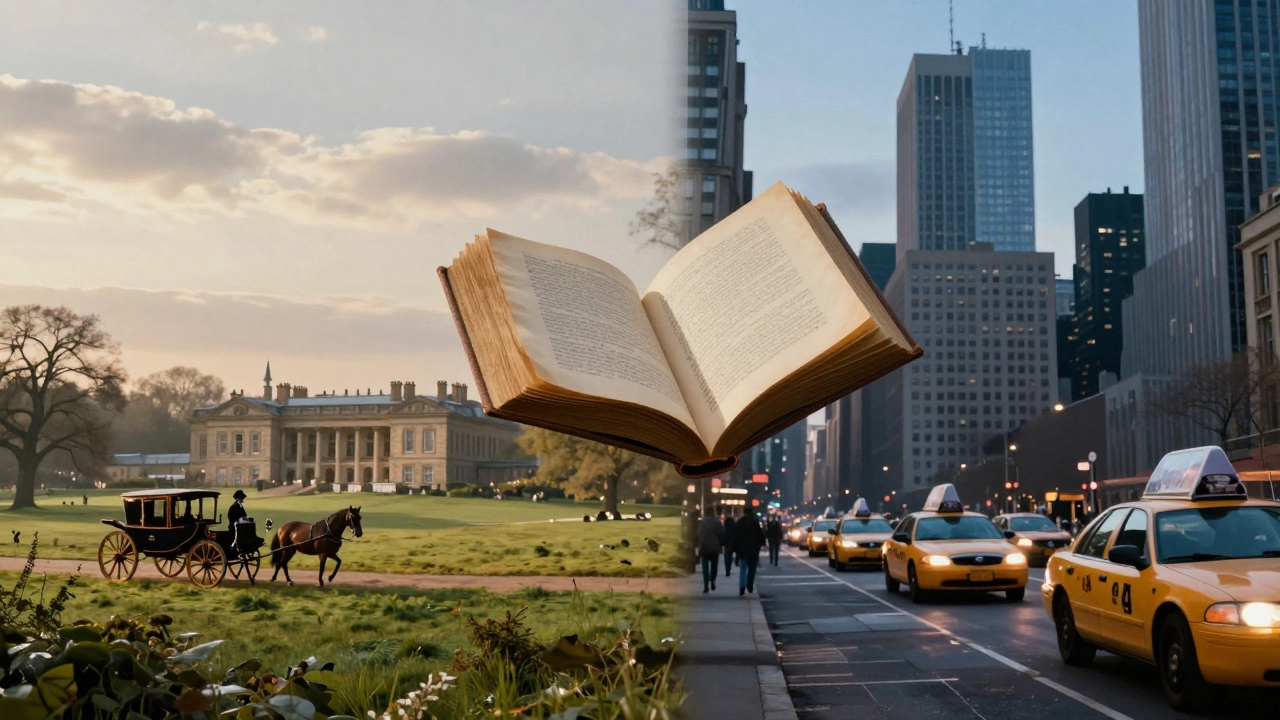
One of the most successful modern shifts is Eligible by Curtis Sittenfeld. Instead of the Longbourn estate, we get the chaos of Manhattan. The Bennet sisters are still desperate for stability, but instead of worrying about a dowry, they're dealing with the brutal reality of New York City rent and dating apps. It proves that the social pressure to marry for security isn't just a 19th-century problem; it's a human problem.
Then there's The Lizzie Bennet Diaries. This wasn't just a book but a transmedia project. It reimagined the story as a series of vlogs. Elizabeth is a grad student filming her life. This change in medium actually enhances the original theme of "first impressions" because we see Lizzie's biased perspective in real-time, making the eventual realization of Darcy's true nature feel even more earned.
| Feature | Original (1813) | Eligible (Modern) | P&P and Zombies (Mash-up) |
|---|---|---|---|
| Setting | Regency England | Modern New York | Zombie Apocalypse England |
| Primary Conflict | Class & Reputation | Career & Social Status | Survival & Class Etiquette |
| Lead Dynamic | Formal Wit | Sarcastic Banter | Combat Partners |
The Mash-up Phenomenon: Zombies and Beyond
Around 2009, a weird thing happened. Authors started mixing classic literature with completely unrelated genres. Pride and Prejudice and Zombies is the poster child for this. On the surface, it looks like a joke, but it actually works because it heightens the stakes. In the original, the "horror" is the prospect of marrying a man you hate or becoming a spinster. In the mash-up, the horror is literal. It turns the Bennet sisters into martial arts experts, blending the societal constraints of the Regency Era with the chaos of a survival horror story.
This trend showed that the plot of Pride and Prejudice is so robust it can survive almost any modification. Whether it's space travel or magical realism, the "will-they-won't-they" tension between a stubborn hero and a sharp-tongued heroine is the engine that drives the story forward.
Subtle Inspirations and "Austen-esque" Fiction
Not every book inspired by Austen is a direct retelling. Some are just "Austen-esque." These books borrow the spirit of the original-the irony, the social observation, and the slow-burn romance-without copying the plot beat-for-beat. For example, many modern Romance Novels use the "Wrong First Impression" trope, which is essentially the DNA of Darcy and Elizabeth.
Consider the works of authors who focus on the domestic sphere and the subtleties of conversation. When you see a story where two people spend 300 pages arguing through subtext and polite conversation before finally admitting they're in love, you're seeing the influence of Jane Austen. She pioneered the idea that a conversation in a drawing-room can be as high-stakes as a battle on a field.
How to Spot a P&P Retelling in the Wild
If you're browsing a bookstore and wondering if a novel is inspired by this specific story, look for these red flags (the good kind):
- The Family Dynamic: A mother obsessed with marrying off her daughters.
- The Outsider: A wealthy, socially awkward lead who offends everyone at a party.
- The Third Party: A charming but deceitful character (the "Wickham" figure) who tricks the protagonist.
- The Epiphany: A moment where the lead realizes their judgment of the other person was completely wrong.
If you find three of these four, you're likely reading a variation of the Pride and Prejudice story. It's a pattern that has proven successful for over two centuries, and it shows no sign of slowing down.
Is there a difference between a retelling and an adaptation?
Yes. An adaptation usually tries to translate the original story into a new medium (like the 2005 movie). A retelling takes the themes or characters and reimagines them in a completely different context, like moving the plot to a modern city or a fantasy world.
Which retelling is best for someone who hasn't read the original?
If you want something accessible, "Eligible" is a great choice because it translates the social pressures into terms we understand today. However, reading the original first allows you to appreciate the cleverness of the retellings much more.
Why are there so many versions of this specific book?
The themes of prejudice, social class, and the danger of snap judgments are timeless. Because the plot is character-driven rather than plot-driven, it's very easy to transplant the characters into any time period or setting.
Are there any sci-fi versions of Pride and Prejudice?
Absolutely. There are numerous indie novels and fan-fiction projects that set the story on space stations or distant planets, replacing the English countryside with galactic empires, but keeping the social etiquette and romantic tension intact.
Does Jane Austen's writing style influence modern authors?
Deeply. Her use of "free indirect speech" (where the narrator's voice blends with the character's thoughts) is a staple of modern literary fiction. Many authors use her technique to create a sense of intimacy and irony.