Many teachers hear "Fountas and Pinnell" and "guided reading" used interchangeably and assume they’re the same thing. They’re not. One is a system. The other is a practice. Confusing them can lead to poor implementation-and that means kids aren’t getting the reading support they need.
What Is Guided Reading?
Guided reading is a teaching method. It’s what happens in a small group of students who are at a similar reading level. The teacher picks a text that’s just challenging enough-so it’s not too easy, but not so hard that the student gives up. Then, the teacher supports the group as they read, asking questions, modeling strategies, and helping them problem-solve when they get stuck.
This isn’t new. Teachers have been doing guided reading since the 1980s. It’s based on the idea that kids learn best when they’re reading real books, not worksheets. You might see it in a first-grade classroom where five kids sit around a table with a book about a dog who learns to swim. The teacher doesn’t tell them every word. She asks: "What do you think will happen next?" or "How did the character solve that problem?"
Guided reading doesn’t come with a script. It’s flexible. It’s responsive. It’s shaped by the kids in front of you.
What Is Fountas and Pinnell?
Fountas and Pinnell is a commercial literacy system created by Irene Fountas and Gay Su Pinnell. It includes books, lesson plans, assessment tools, and a leveling system. You’ve probably seen the colored bands on the spines of books-green for level D, blue for level J, and so on. That’s Fountas and Pinnell.
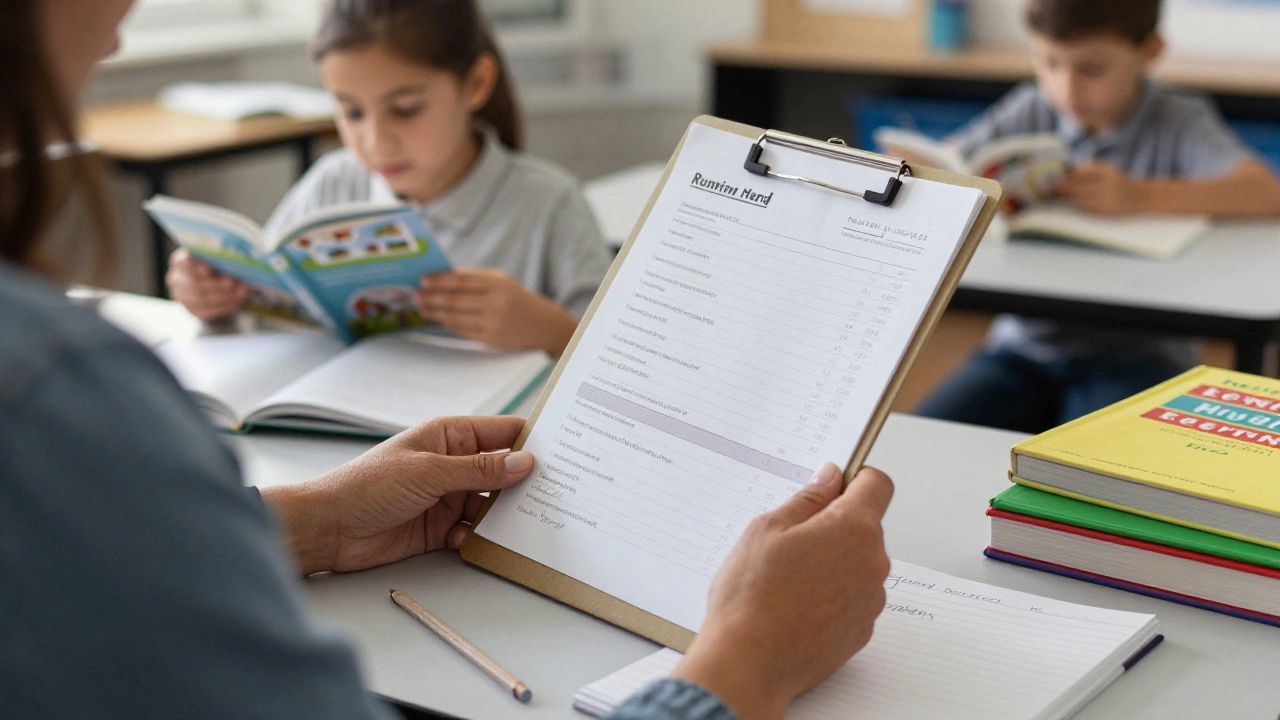
Their system gives teachers a structure. It tells you how to assess a child’s reading level using a running record. It provides lesson templates. It organizes books into levels from A to Z+. It even includes professional development materials for schools.
But here’s the catch: Fountas and Pinnell doesn’t invent guided reading. It packages it. Think of it like a recipe book. Guided reading is the cooking. Fountas and Pinnell is the cookbook with exact measurements, labeled ingredients, and step-by-step photos.
Why the Confusion?
School districts buy Fountas and Pinnell kits. They train teachers to use them. Soon, everyone starts saying "We do Fountas and Pinnell" when they mean "We do guided reading." The brand name becomes the method name.
It’s like saying "I use Kleenex" when you mean "I use tissues." One’s a brand. The other’s the thing itself.
But this isn’t harmless. When schools treat Fountas and Pinnell as the only way to do guided reading, they lose flexibility. Teachers start matching kids to levels like they’re sorting socks. A child who reads at level L gets a level L book-no matter if they’re bored, or if the topic doesn’t connect to their life.
Real guided reading doesn’t require a specific book series. You can use any book that matches the student’s level and interest. You can use library books, picture books, nonfiction from online sources. Fountas and Pinnell just gives you one set of books to choose from.
The Real Difference
Guided reading is a teaching practice. Fountas and Pinnell is a curriculum.
- Guided reading: small group, text-based, strategy-focused, teacher-guided, responsive.
- Fountas and Pinnell: branded, leveled-book system, scripted lesson guides, standardized assessments, commercial product.
You can do guided reading without Fountas and Pinnell. Many teachers do. They use the Reading Recovery model, or the Lucy Calkins approach, or even their own designs.
And you can use Fountas and Pinnell without true guided reading-if you just hand out leveled books and call it a day. That’s not guided reading. That’s book distribution.
What Works Best?
Research doesn’t favor one system over another. What matters is how you use it.
A 2023 study from the National Center for Education Statistics found that students made the most progress when teachers:
- Used texts that matched students’ reading levels
- Provided immediate feedback during reading
- Encouraged students to talk about meaning, not just decode words
- Adjusted instruction based on student responses
None of those require Fountas and Pinnell. They just require good teaching.
Some schools swear by Fountas and Pinnell because it brings consistency. Teachers get the same training. The same books. The same assessments. That helps when you have high turnover or new teachers.
But if you’re using it as a crutch-following the lesson plan without listening to your kids-you’re missing the point. Guided reading is about relationships, not resources.

Practical Takeaway
Ask yourself: Are you teaching reading, or are you following a kit?
If your students are reading books from a Fountas and Pinnell box, but they’re not talking about the story, asking questions, or making connections-you’re not doing guided reading. You’re just handing out books.
Good guided reading looks like this:
- A child struggles with the word "bounced." The teacher says, "Try chunking it. What part do you know?"
- A student says, "I think the character is lying." The teacher asks, "What made you think that?"
- A group finishes reading and writes down one thing they learned-or one thing they wonder.
None of that needs a Fountas and Pinnell manual. It just needs a teacher who knows how to listen.
Final Thought
Fountas and Pinnell is a tool. Guided reading is the skill. You can have the best tool in the world and still not build anything meaningful if you don’t know how to use it.
Don’t let the brand name fool you. The goal isn’t to complete a leveled book series. The goal is to help every child become a reader who thinks, questions, and loves stories.
Is Fountas and Pinnell required for guided reading?
No. Guided reading is a teaching method that can be done with any leveled texts. Fountas and Pinnell is just one brand that provides books, assessments, and lesson plans to support guided reading. Many teachers successfully use other resources like classroom libraries, online texts, or teacher-created materials.
Can I use Fountas and Pinnell without doing guided reading?
Yes-and many schools do. If you hand out Fountas and Pinnell books and assign independent reading without small-group instruction, feedback, or strategy support, you’re not doing guided reading. You’re just using their materials. That’s not effective. Guided reading requires interaction, not just books.
Are Fountas and Pinnell levels accurate for all students?
They’re a general guide, not a perfect measure. Some students read at a higher level for comprehension but struggle with fluency. Others read slowly but understand complex ideas. Fountas and Pinnell levels are based on word count, sentence structure, and vocabulary-but not on background knowledge, critical thinking, or motivation. Always use them alongside observation, not as the only decision-maker.
What are alternatives to Fountas and Pinnell for guided reading?
Many exist. The Reading Recovery model, the Lucy Calkins Units of Study, and the workshop model are popular. Some schools use open-source leveled readers from websites like Newsela or ReadWorks. Others build their own collections using library books, picture books, and nonfiction texts. The key is matching text complexity to student ability-not following a branded sequence.
Do all students need guided reading?
Not every student needs it every day. Strong readers benefit from independent reading and literature circles. Struggling readers need more support, often in small groups. The goal is to use guided reading strategically-when students need help with comprehension, fluency, or problem-solving strategies-not as a daily routine for everyone.