
Adult fantasy books are often the primary target for this question. Unlike Young Adult (YA) stories, where the focus is usually on coming-of-age and first loves, adult titles handle complex themes, graphic violence, and explicit sexual content. But there is a massive difference between a book that happens to have some sex and a book where the sex is the main point. That's where the naming conventions get a bit messy.
The Broad Umbrella: Adult Fiction
At the most basic level, any book written for readers 18 and older falls under Adult Fiction. This is a broad category that encompasses any narrative work intended for a mature audience. However, calling a book 'Adult' doesn't automatically mean it's explicit. A gritty political thriller or a dense historical biography is technically 'adult fiction,' but you won't find them in the restricted section.
When people specifically ask for '18+ books,' they are usually talking about the content rather than the target demographic. In the industry, if a book contains explicit sexual descriptions, it moves from being simply 'adult' to being 'explicit' or 'erotic.' For a reader, this is the difference between a story with a 'closed-door' romance (where the scene cuts to black) and an 'open-door' romance (where everything is described in detail).
Defining New Adult (NA) Fiction
There's a weird middle ground called New Adult. This isn't a formal category used by every publisher, but it's a massive trend in bookstores. New Adult fiction focuses on the 18-to-25 age range, covering the transition from college to the professional world. It's essentially the bridge between the innocence of YA and the stability of traditional Adult fiction.
In the realm of fantasy, New Adult is where you'll find the 'spiciest' content. Think of stories where the protagonists are in their early twenties, dealing with university-style drama but with magic, demons, or fae. Because these characters are legally adults, authors feel more freedom to include graphic content that would be taboo in a YA novel. If you see a book labeled 'NA' on a site like Goodreads, expect more mature themes and more frequent intimate scenes than you'd find in a standard teenage fantasy.
The Distinction Between Romance and Erotica
This is where most of the confusion happens. Many people use 'erotica' as a catch-all term, but in the publishing world, they are two very different entities. To understand this, we have to look at the Romance Novel. A romance novel is defined by two things: a central romantic relationship and an 'Happily Ever After' (HEA) or 'Happily For Now' (HFN) ending. The sex in a romance novel supports the emotional plot.
On the other hand, Erotica is a genre where the primary focus is on sexual arousal and the exploration of sexual desire. In erotica, the plot often exists solely to facilitate the sexual encounters. While a romance novel might have a few spicy scenes, erotica is built around them.
| Term | Primary Focus | Explicit Content Level | Common Examples |
|---|---|---|---|
| Adult Fiction | Complex themes/Plot | Variable (Low to High) | Literary novels, Thrillers |
| New Adult (NA) | Early adulthood (18-25) | Moderate to High | Campus fantasies, Romantasy |
| Romance | Emotional connection/HEA | Low to High (Closed vs Open) | Contemporary Romance, Regency |
| Erotica | Sexual gratification | Very High | Explicit erotic shorts/novels |
The Rise of Romantasy
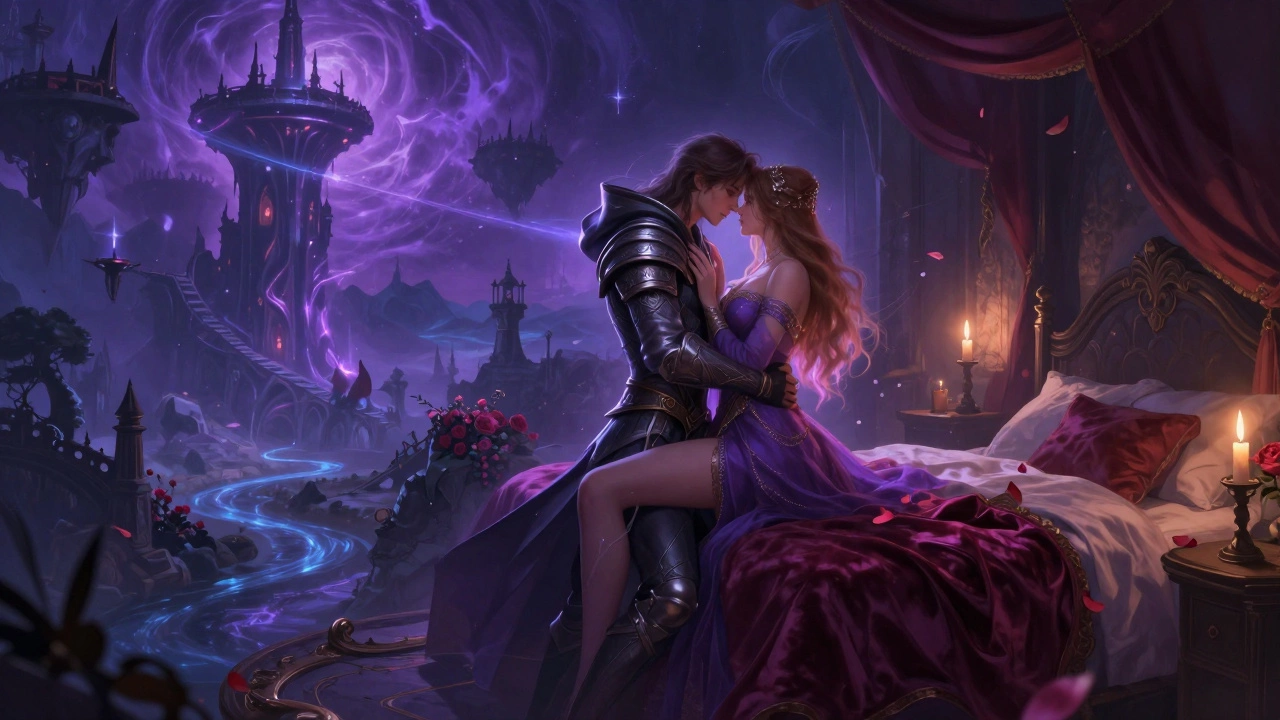
If you've spent any time on 'BookTok,' you've seen the word Romantasy. This is a portmanteau of 'Romance' and 'Fantasy.' It's a powerhouse subgenre that has pushed many 18+ books into the mainstream. Romantasy blends high-stakes world-building (think warring kingdoms or magical systems) with intense, often explicit, romantic arcs.
The appeal of Romantasy is that it provides a safe space to explore desire within an escapist setting. When a Romantasy book is labeled as 18+, it usually means it has high 'spice' levels. In the community, authors often use a 'spice scale' (like peppers) to tell readers exactly how explicit the book is. One pepper might mean a few kisses; five peppers mean the book is practically erotica with a side of magic.
Content Warnings and Trigger Warnings
Because 18+ books can venture into dark territory, the industry has shifted toward transparency. You'll often find a section at the beginning of a book-or a link in the author's bio-listing Content Warnings. These are disclaimers that alert readers to potentially distressing themes, such as graphic violence, non-consensual encounters, or trauma.
This is especially true in 'Dark Romance' or 'Grimdark Fantasy.' In these genres, the 18+ rating isn't just about sex; it's about the psychological weight of the story. A book can be 18+ because it features a protagonist who commits atrocities, even if there isn't a single sex scene in the entire novel. This distinction is why checking the labels is so important; 'Adult' can mean 'sexual' or it can mean 'deeply disturbing.'

How to Find the Right Label
So, how do you actually find these books without getting lost in a sea of generic categories? Most modern bookstores and libraries use a mix of these terms, but if you're searching online, use specific keywords. If you want the plot and the steam, search for 'Open Door Romantasy.' If you want purely sexual content, search for 'Erotica.' If you want a story about a 20-year-old discovering magic and love, look for 'New Adult Fantasy.'
It's also helpful to look at the publisher. Some imprints specialize in 'Adult' content, while others stick to YA. For instance, if a book is published by a label known for 'Dark Romance,' you can bet it's an 18+ experience regardless of whether the word 'Adult' is on the cover. The labels are evolving, and while the terminology might feel confusing, it's all about matching the reader's expectations with the author's intent.
Is 'Adult' the same as 'Erotica'?
No. 'Adult' is a broad target demographic (anyone 18+). Erotica is a specific genre where sexual content is the primary focus of the plot. Most adult books are not erotica.
What does 'New Adult' mean exactly?
New Adult (NA) refers to fiction featuring protagonists aged roughly 18 to 25. It focuses on themes like starting university, first real-world jobs, and the transition to adulthood, often with more explicit content than Young Adult (YA) books.
What is a 'Closed Door' romance?
A 'closed door' romance means the romantic tension is high, but the sexual acts happen 'off-screen.' The scene usually ends as the characters enter the bedroom, and the next chapter starts the following morning.
Why are some 18+ books not labeled as erotica?
Many books are 18+ because of violence, coarse language, or dark themes rather than sex. Additionally, a romance novel may have explicit scenes but is still classified as 'Romance' because the emotional relationship and the happy ending are the priority.
What is 'Romantasy'?
Romantasy is a hybrid genre that combines elements of epic fantasy (world-building, magic, quests) with the tropes of romance novels (strong romantic tension, detailed relationship development, and often explicit intimacy).
Next Steps for Readers
If you're exploring this world for the first time, start by checking reader-driven databases like StoryGraph or Goodreads. Users often tag books with 'spice levels' or specific content warnings that publishers might omit. If you're a writer trying to label your own work, be honest about your 'door' status-tell your readers if the book is open-door or closed-door to avoid frustrating your audience.
For those who prefer high-fantasy but want to avoid explicit content, look for 'Clean Romance' or 'Sweet Romance' tags. Conversely, if you're looking for the most intense 18+ experiences, dive into the 'Dark Romance' or 'Erotica' sections of indie publishing platforms, where authors have more freedom to push boundaries than they do with traditional publishing houses.